Intelligent HVAC
learns your house.
A Home Assistant integration that learns how your house heats and cools — so it's warm when you wake up, and you know when to open a window instead of running the AC.
- Status
- Public beta — v1.2.0b2, November 2026
- License
- GPL-3.0
- Install
- HACS custom repository
Smart thermostats guess.
This one measures.
Programmable thermostats run fixed schedules: start heating at 5:30. Too early wastes a night of gas. Too late means a cold house. The "smart recovery" features that are supposed to fix that are a black box — and they don't know your house, your furnace, or tonight's weather.
Intelligent HVAC reads the thermostat and temperature history already sitting in Home Assistant and learns two numbers for your home: how fast it loses heat, and how strong the furnace is. From those it works out when to start heating so the house reaches your target at wake-up. In my own home, its predictions land within about four minutes of real heat-ups.
How fast the house sheds heat, fit from the stretches when the furnace is off.
How hard the furnace pushes back, fit from long heating runs.
Everything else — tonight's start time, the window-versus-AC call — falls out of those two numbers and the outdoor temperature.
Six jobs, one integration.
From the Home Assistant recorder history it fits a first-order thermal model of the home: the heat-loss rate, measured while the furnace is off, and the heating power, measured across long heating runs.
It solves for the recovery time — 65 → 70°F, say — at the current outdoor temperature. Colder nights mean an earlier start, by construction rather than by guesswork.
In cooling season it compares indoor, outdoor and forecast temperatures, and suggests windows over AC when that will hold the house comfortably.
A plain fallback automation raises the heat if the smart start hasn't happened by a fixed lead time, and leaves a notification saying so. A bad model can't leave you with a cold morning.
A ready-made dashboard shows tonight's plan — setback, heat-up start, wake-up — a one-tap Pause / Resume for everything that touches the thermostat, and what the model has learned and when it last refit.
No cloud and no account. Everything runs inside Home Assistant, on hardware you already own.
Tonight's plan, what the model learned, and a pause button.
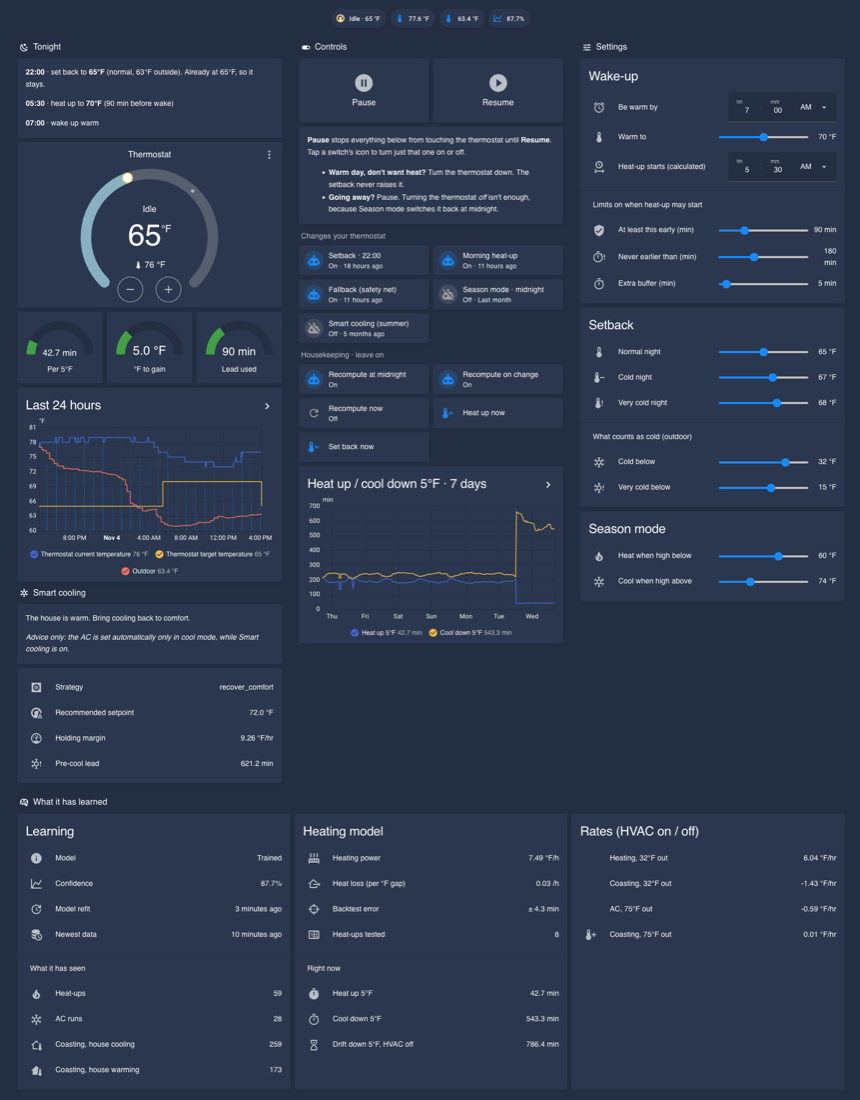 [ shipped dashboard · my house ]
Setback time, the heat-up start the model picked, and the wake-up target it's aiming at — before the night happens, not after.
The heat-loss rate and furnace power fit for this house, the measured backtest error behind the confidence number, and when the model last refit.
One tap stops everything that touches the thermostat. One tap starts it again. No YAML, no digging through automations.
The first version worked.
It was also far too cautious.
Version one learned a model of my house and ran my furnace, and last winter — on the genuinely cold days — it got the timing right. On mild days it hedged: it started the heat around 4 AM for a 7 AM wake-up on a 50°F morning, just in case.
So I rebuilt the heating model on physics instead of heuristics — heat-loss rate and furnace power, each a number with units. Both versions are scored below against the same eight real heat-ups from this fall, with outdoor temperatures from 44 to 69°F.
| Measure | First version | Now (v1.2) |
|---|---|---|
| Average timing error | 128 min (always too early) | 4.3 min |
| 65→70°F with 50°F outside | 177 min | 43 min |
| Model confidence | 58% | 88% |
That's a 97% smaller timing error. On a 50°F morning the heat now starts more than two hours later than it used to — and still lands on time. Each new prediction is scored against real heat-ups it never trained on, and the confidence shown on the dashboard is that measured error, not a vibe.
Refining, and retesting through a real winter.
The new model has only seen fall weather so far, down to 44°F outside. This winter is the real test — the cold days the first version handled well. Every beta runs in my own home first, and I watch how each morning turns out.
Nothing is left to chance while that happens. A nighttime setback only ever lowers the thermostat, never raises it. If the smart heat-up doesn't happen, the backup automation raises the heat and sends a notification. Everything that touches the thermostat can be paused from the dashboard with one tap.
"Automation that controls your house shouldn't be trusted blindly — so we monitor the outcomes."
It runs my furnace, so it gets real tests.
Unit tests for the physics and the data pipeline, plus an end-to-end run against a real Home Assistant instance in Docker — on both the stable and beta channels.
Old learned data is archived, never deleted, and the live install was backed up before cutover.
GitHub Actions running hassfest, HACS validation, pytest, the sandbox end-to-end run, CodeQL and Dependabot, with tag-driven releases on beta and stable channels.
- Python
- Home Assistant
- config flow
- DataUpdateCoordinator
- recorder
- HACS
- Docker
- GitHub Actions
- CodeQL
- Claude Code
Every house teaches the model something different.
Running Home Assistant with a smart thermostat? Install the beta through HACS as a custom repository and tell me how your mornings go. The heat-loss rate, furnace power and backtest error it learns for your home are all on the dashboard — sharing them in a GitHub issue makes it better for everyone.
Intelligent HVAC is free software under the GPL-3.0, built and maintained by Joe Henzi. It is a personal open-source project, not one of Henzi's Services LLC's commercial products — there is no account, no cloud service and nothing to buy.